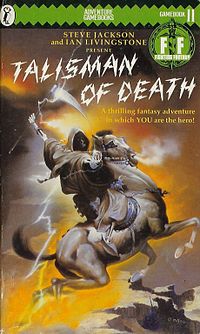
If you're reading these reviews in order of publication, you may be confused. Why is my second review for the eleventh Fighting Fantasy to be released? There's a simple answer: it was the second book I've got. For whatever it's worth, I'm going to be reviewing these books in the order, as far as I remember, that I played them in (and the cover I use will be the version I first owned, in case you're curious).
Whilst the book list in the front of The Warlock of Firetop Mountain meant I was technically aware of the existence of other books in the series, as it was an old book, the idea of actually getting others didn't occur to young me (I think the Wizard series was actually being printed by this point, but I wasn't aware of it). So it was only a chance spot whilst shopping with my mum in a charity shop that saw me obtain Talisman of Death and turn Fighting Fantasy from 'a book I have' into an actual hobby. Anyway, on to the review:
As a book
It didn't register until it was pointed out to me, but the plot of Talisman of Death is basically that of Lord of the Rings - you have to save the world of Orb from the potential power of the titular Talisman by transporting it back to your own world (you are actually a normal person from Earth, transported to Orb by its' gods and granted the capabilities of an at-least-fairly-capable warrior), so it's not a one-for-one clone, but when you factor in your being chased by mounted wraiths and being saved by an eagle at different points of the book, the comparisons become fairly obvious. A bit of a lack of originality doesn't detract from the book, though, which is excellently written.
For clarity the whole 'you are actually from Earth' isn't particularly relevant to the book, but it's a neat plot device in that it justifies a) the book 'dropping you in' to the world, b) you not having any preexisting knowledge of Orb and c) triumphing by taking the Talisman successfully through the portal to Earth isn't condemning your character to leaving their life behind and trying to get by in an alien world (although that would be interesting from a narrative perspective).
Anyway, the world of Orb is very well-realised through descriptive writing and a coherent sense of place, and although most of its' inhabitants are not unlike those you might encounter in the established Fighting Fantasy world (to the extent that it was established when ToD was released), the whole environment feels distinctive, with a flavour of it's own. Whilst no individual characters get a huge amount of page-time, most people that you meet have their personalities well conveyed during the time you spend with them. Similarly, the locations that you do visit all have their own sense of atmosphere that makes you want to explore as many different paths through the books as possible, and the overall journey feels suitably . I'd go so far as to say that it's one of the best-written books in the series and is well worth reading even if you don't intend to play it 'properly'.
As a game
There's a unique aspect to Talisman of Death that needs to be described first, so that any assessment of difficulty can be understood in the proper context. Basically, there's a sort-of checkpoint/resurrection system and a lot of would-be instant deaths send you back to either pretty much the start of the book, or after exiting the city which forms the middle part of the book (your inventory gets reset too, so it's not something you can game). Going back to the first checkpoint is obviously similar to just restarting (but you get to keep good stats if you rolled them!), but the second is much further in a means that making a mistake or missing an item in the last portion of the book doesn't have to lead to the frustration of losing all your progress as you'll only have to replay a relatively small portion of the book. There are still actual instant deaths, primarily if you fall into the clutches of the servants of Death rather than just dying somehow and as far as I'm aware, death in combat is permanent, which is a little inconsistent if you're killed by a normal opponent and would be frustrating if you narrowly lose one, but might overall save some frustration because...
Combats are mostly fair/avoidable, but with two mandatory fights with Skill 12 opponents. Both of these in themselves can be made easier if you've taken the best path to reach them, but even in that scenario, a character without stats in the upper range of things will be fighting an uphill battle. So, to circle back to the previous paragraph, there probably wouldn't be much point in a Skill 7/8 character getting repeatedly resurrected and brute-forcing through most combats, because they aren't getting past the big 2 anyway (I mean, it's not actually impossible, but it'd be orders of magnitude quicker and less tedious to just restart with a stronger character).
I do mark the book down slightly for the two fights in question as, even though it's narratively reasonable that they're as tough as they are (one far moreso than the other, really), they can come across as unfair difficulty spikes in an otherwise pretty-well balanced book.
Combat aside, the book is pretty fair. The checkpoint system, as discussed, mitigates a lot of failure options and usually, making a mistake in a given situation means that getting through it is just harder, not impossible. At lot of the actual failures (and the ones you can be resurrected from) arise from doing something a bit stupid too - you're not required to make counter-intuitive decisions in order to succeed and you don't get the feeling that the book wants you to fail it, like you do with some others. Overall, with the exception of the aforementioned combats, the difficulty is pitched very well indeed.
The art
Another good outing for the artwork, with several striking images. I do appreciate how pretty much every character of note gets an illustration, which helps a lot with forming a mental image of your journey.
Overall
I've tried to be restrained in the main portion of this review, but I really do love this one. There's a bit of a nostalgia impact, but it's genuinely superbly written and nearly every aspect of the game side of things, it gets right. Despite the nitpick with the difficulty curve and the fact that it arguably lacks a truly original/memorable aspect/encounter to set it apart from other books, it's definitely in the top tier for me. 9/10.


